






I think BDSM humiliation is one of those topics people are curious about long before they feel comfortable saying it out loud.
Table Of Content
- What BDSM humiliation actually means
- Why humiliation can feel so intense
- The part nobody should skip: negotiation
- A yes, no, maybe conversation helps more than people think
- What safe humiliation play usually looks like
- Public humiliation is where people get reckless
- Verbal humiliation can hit harder than anything physical
- Aftercare matters more here than people admit
- If you are curious but nervous, start softer than you think
- A small note on resources
- Where I land on it
Not because it is automatically extreme, and not because it means something is wrong with you, but because it sits in a weird, intimate corner of desire. It mixes power, vulnerability, embarrassment, trust, ego, and fantasy in a way that can feel surprisingly intense, even if nothing “big” is happening on the surface.
For some people, BDSM humiliation is about being seen in a softer, more exposed way. For others, it is about giving up control, letting go of pride, or stepping into a role that feels taboo enough to be exciting. And for plenty of people, the actual turn-on is not the humiliation itself, but the closeness that comes from handing someone that much trust.
That part matters more than the fantasy.
Because when people search for BDSM humiliation ideas, they usually find one of two things: either a huge chaotic list of dares and insults, or a cold, clinical explanation that somehow sucks all the life out of it. Neither one really gets to the heart of it. What makes humiliation play work is not how “wild” it sounds. It is whether it feels consensual, specific, and emotionally safe for the people involved.
Humiliation only works as kink when trust is stronger than the sting.
That is really the line for me. Without that foundation, it stops being play and starts becoming cruelty, which is not sexy, just lazy.
What BDSM humiliation actually means
BDSM humiliation usually refers to consensual play where embarrassment, shame, awkwardness, exposure, or a blow to the ego becomes part of the dynamic. Sometimes it overlaps with degradation, but I do not think they always feel the same.
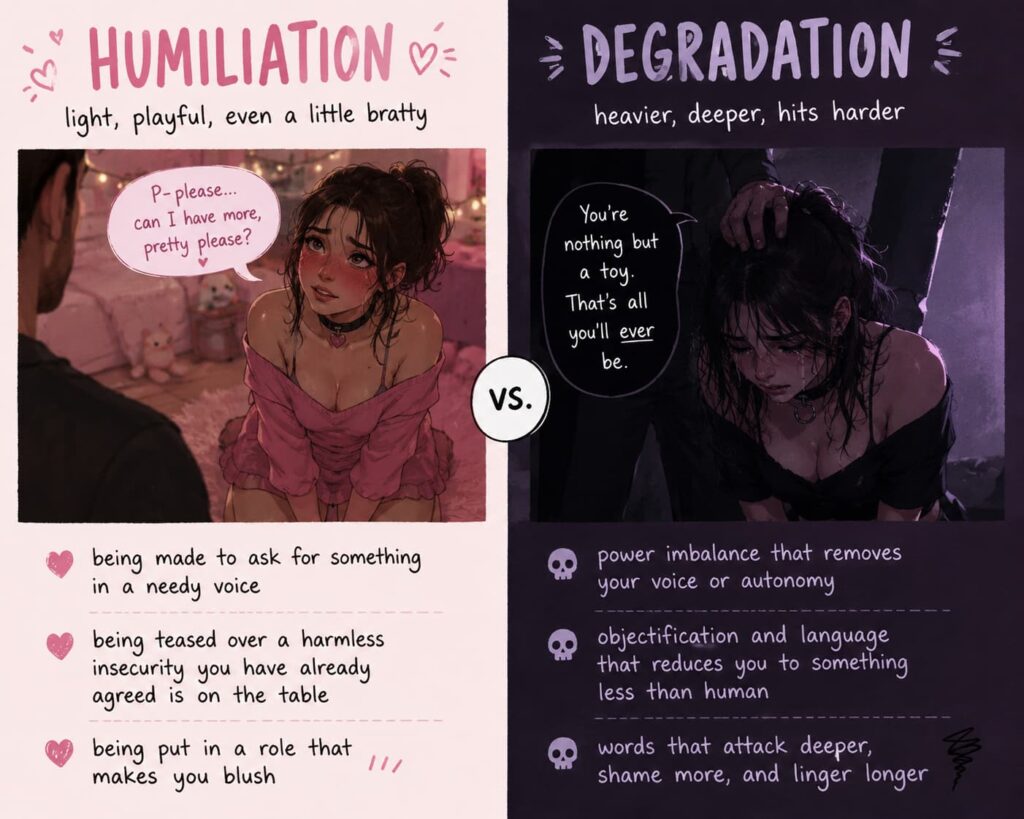
Humiliation can be light, playful, even a little bratty. It might be being made to ask for something in a needy voice, being teased over a harmless insecurity you have already agreed is on the table, or being put in a role that makes you blush. Degradation tends to feel heavier. It usually goes deeper into power imbalance, objectification, or language that hits harder emotionally.
You May Also Like: What a BDSM Playroom Actually Is?
The difference is personal, honestly. One person might melt over being called “needy,” while another feels nothing from that but gets completely wrecked by being corrected, laughed at, or made to feel small in a more psychological way. ( you may alos like to read more about Sensual sex made things feel more personal)
That is why copying random humiliation scenes from the internet is such a bad idea. The hottest version of this kink is usually the one that feels tailored, not the one that sounds the most shocking.
Why humiliation can feel so intense
A lot of kink lives in the gap between real life and roleplay, and humiliation is especially good at playing in that gap. It pulls on identity. Pride. Self-image. The version of ourselves we try to present to other people.
When that gets touched in a controlled, consensual setting, it can create a kind of emotional electricity that is hard to fake. Some people feel relief in not having to be composed or impressive. Some like the ache of surrender. Some enjoy being “brought down” by someone they trust because it flips everyday power on its head.
There can also be a weird tenderness underneath it. That sounds contradictory, but it is true. Being allowed to feel exposed with someone who is still paying attention to your limits can be incredibly intimate. Sometimes the vulnerability is the point.
Still, this is exactly why humiliation kink needs more care than people assume. You are not just playing with words or roles. You are playing near the edges of self-esteem, shame, history, and sometimes old wounds. That deserves more thought than “let’s just wing it.”
The part nobody should skip: negotiation
I know negotiation is not the sexiest word on earth. It sounds like you are drawing up a rental agreement before making out. But with humiliation play, this is where everything important happens.
The biggest mistake people make is being too vague.
Saying “I’m into humiliation” is not enough.
That can mean dozens of different things. It can mean light teasing. It can mean verbal humiliation. It can mean service, exposure, embarrassing clothing, strict rules, orgasm control, roleplay, or power-based rituals that have very little to do with insults at all.
You need specifics.
Talk about what kind of humiliation feels hot, what feels neutral, and what is absolutely off-limits. (You May Also Like: Why Coming on the Face Can Feel So Hot) Some people love pet names and mock scolding but do not want body comments anywhere near the scene. Some enjoy public-adjacent embarrassment like wearing something under their clothes, but only if nobody else is actually involved. Some like being ordered around but hate being laughed at.
A simple way to sort it out is this:
| Area | Usually safer to start with | Often needs more caution |
|---|---|---|
| Verbal play | playful teasing, needy praise, mild correction | body shame, intelligence, family, trauma-linked insults |
| Situational play | private rules, service, awkward tasks at home | anything involving real public exposure or third parties |
| Power play | permission-based rituals, posture, titles | emotional humiliation that lingers after the scene |
| Sexual humiliation | mild embarrassment, guided language | anything coercive, painful, or tied to lasting shame |
That table looks annoyingly sensible, but it saves people a lot of avoidable damage.
A yes, no, maybe conversation helps more than people think
I genuinely think humiliation kink gets easier once you stop treating it like one giant category.
Instead of asking, “Are you into BDSM humiliation?” ask smaller questions. Are you okay with teasing? With being given instructions? With certain names? With correction? With role-based dynamics? With service? With orgasm denial? With embarrassment that stays private? With anything that might carry into real life?
This is where a yes, no, maybe list can be surprisingly useful. Not because it is romantic, but because it forces honesty.
“Maybe” is especially important here. A lot of people do not know what will land until they try it gently. A phrase that sounds hot in theory can feel awful in the moment. Something that seemed silly can suddenly hit hard in the best way. You are learning a language together.
What safe humiliation play usually looks like
Not dramatic. That is the funny part.
The best BDSM humiliation scenes are often built from details, not spectacle. A rule about how someone asks for attention. A ritual that makes them feel exposed. A tone shift. A command to repeat a phrase. Being kept waiting. Being corrected. Being made to admit what they want. Being put in a position that feels submissive without crossing into anything emotionally reckless.
That is usually more effective than going straight for the harshest language you can think of.
If you are new to it, I would keep everything private, specific, and easy to stop. You want room to notice how it actually feels in your body afterward, not just whether it sounded hot for five minutes. There is a big difference between a flushed, shaky, thrilled kind of vulnerability and the hollow feeling of “that actually upset me more than I expected.”
Your body usually knows first.
Public humiliation is where people get reckless
This is the part where I have to be a little less playful for a second.
A lot of so-called public humiliation ideas online are careless at best. If strangers are being pulled into your scene without consent, that is not edgy. It is just dragging uninvolved people into your kink. Also, depending on what you are doing, it can become unsafe or illegal very fast, which is a stupid reason to ruin your day.
There is a big difference between private humiliation, semi-private roleplay, and actual public play.
Wearing something hidden under your clothes because it makes you feel flustered is one thing. Being sent out to do something that risks exposing non-consenting people is another. If you want that feeling of exposure, there are safer ways to create it without making the world participate in your dynamic.
That boundary is worth keeping.
Verbal humiliation can hit harder than anything physical
I think this is what surprises people the most.
A lot of BDSM beginners assume humiliation has to look dramatic, but words can do more than a whole pile of props if they tap into the right dynamic. The catch is that verbal humiliation is also where you can do the most accidental harm.
Anything tied to real trauma, body shame, eating issues, intelligence, class, family, gender dysphoria, or deeply personal insecurities deserves extra caution. Sometimes those areas are part of the kink. Sometimes they are absolutely not. You do not guess.
The safest verbal play usually starts with language that is clearly role-based, clearly erotic, and clearly agreed on. You can always build from there. You do not get points for being “intense” if the scene falls apart and your partner spends the next two days feeling awful.
Aftercare matters more here than people admit
I do not care how experienced someone is. If you are doing humiliation play, aftercare is not optional.
That does not always mean a giant emotional debrief and twenty blankets. Sometimes it is simple. Reassurance. Water. Holding each other. A check-in. A reminder that the scene is over and the relationship is still intact. Sometimes it is hearing, very clearly, “I meant what I said in the scene for the scene, not as a statement about you.”
Because humiliation can linger in a strange way. Even when someone liked it, they might still feel a drop afterward. They might need to hear that they did well, that they are safe, that the power dynamic has closed properly.
People love skipping aftercare right up until they learn why they should not.
If you are curious but nervous, start softer than you think
You do not need to leap straight into degradation to explore this kink. In fact, I think most people have a better experience when they start with lighter humiliation and pay close attention to what actually creates tension.
Maybe it is being made to ask nicely. Maybe it is being told to hold a posture, follow a rule, or confess a fantasy out loud. Maybe it is service, ritual, eye contact, correction, or being called out in a playful but controlled way. Maybe it is just the feeling of being seen as a little greedy, needy, or desperate by someone you trust.
That is still real BDSM humiliation. It does not have to look extreme to be effective.
And if you are exploring solo, there is still room for that curiosity. Journaling fantasies, noticing what kind of language or scenarios spark embarrassment, and separating “this turns me on” from “this would actually hurt me” can teach you a lot before you ever bring someone else in.
A small note on resources
If you want a more community-based explanation of risk-aware BDSM practices, the National Coalition for Sexual Freedom has educational material worth browsing, especially around consent and negotiation. It is not exactly bedtime reading, but it is useful: NCSF.
Where I land on it
I do not think BDSM humiliation is about being mean for the sake of being mean. At least, not when it is good.
At its best, it is a very particular kind of intimacy. One person says, in effect, “Here is a vulnerable part of me. Handle it carefully.” And the other person does. Even when the scene itself is sharp, embarrassing, or emotionally loaded, the structure holding it up is still trust.
That is why the hottest part is never the insult, the rule, or the role. It is knowing the other person understood the assignment.
So if BDSM humiliation is something you are curious about, I would not focus on finding the most outrageous ideas. I would focus on finding the version that feels honest, negotiated, and weirdly safe. The version that leaves you flushed, maybe a little shaken, but still very sure you were cared for.
That is the difference between a fantasy that deepens connection and one that just leaves a bruise in the wrong place.





No Comment! Be the first one.