





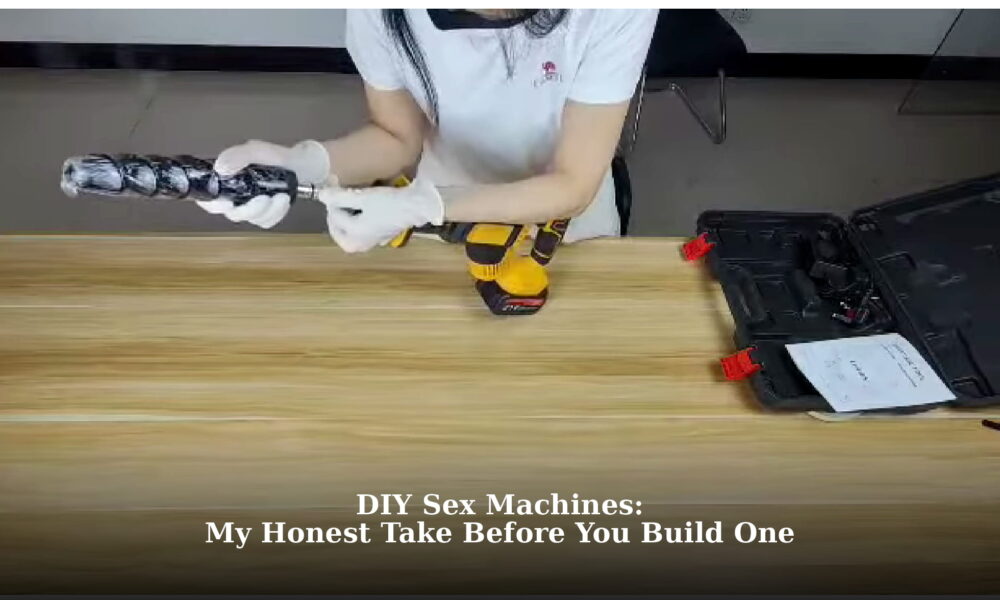
I’m not even going to pretend this topic didn’t start as a late-night curiosity spiral.
Table Of Content
You know the kind… one search leads to another, and suddenly you’re watching someone turn a power tool into something that definitely wasn’t in its original job description. And instead of clicking away, you kind of pause and think, wait… people actually build these?
That’s where DIY sex machines sit for me. Somewhere between “this is oddly creative” and “should I be slightly concerned about humanity?”
But also… I get it.
There’s something about control, customization, and hands-free exploration that makes people curious. And once you realize you can build something tailored exactly to what you like, the idea becomes less weird and more… interesting.
Still, there’s a difference between curiosity and actually doing it.
The appeal is not what you think
At first glance, DIY sex machines sound purely mechanical. Like it’s all about speed, power, and pushing things further. But the more I looked into it, the more I realized the appeal is actually quieter than that.
It’s about control.
Being able to adjust movement, rhythm, intensity… without relying on someone else or a fixed toy setting. It’s kind of like building your own version of pleasure instead of adapting to what’s already out there.
“It’s not really about the machine. It’s about removing effort and adding intention.”
That line stuck with me more than anything else.
Because honestly, most people aren’t trying to build something extreme. They’re just trying to create something that fits them better than a generic product.
Starting simple vs going full DIY chaos
This is where things split into two very different paths.
Some people start simple. And by simple, I mean creatively using what already exists. Adjusting toys, attaching things to stable surfaces, making them hands-free. No wires, no motors, no engineering degree required.
Then there’s the other side… the “I’m about to build a machine from scratch” crowd.
And that’s where things get serious.
Here’s how I’d personally look at it:
| Approach | What it feels like | Reality check |
|---|---|---|
| Simple DIY setups | Low effort, curious, experimental | Actually doable for most people |
| Modified tools (drill-style setups) | Powerful, flexible | Can get risky fast if careless |
| Full machine build | Custom, intense, “engineer mode” | Time, cost, and safety matter a lot |
The jump between those levels is bigger than people expect.
One minute you’re adjusting a toy on a chair, and the next you’re wiring a motor and wondering why it’s vibrating like it wants revenge.
The part nobody romanticizes: safety
This is the least exciting part to talk about, which is probably why people skip it.
But if you’re dealing with motors, moving parts, or anything that spins, thrusts, or applies force… you’re not just “experimenting” anymore. You’re building a machine. And machines don’t care about your comfort.
What surprised me is how quickly things can go wrong if something is unstable or poorly attached. It’s not even about extreme scenarios. It’s the small things. A loose part. Too much speed. A material that wasn’t meant for pressure.
And suddenly your fun project turns into a very bad story you won’t want to tell anyone.
If anything, this is the line I wouldn’t ignore:
If you wouldn’t trust it running unattended, you probably shouldn’t trust it near your body.
Not exactly sexy, but definitely useful.
Is it actually cheaper… or just looks like it?
On paper, DIY sex machines seem like a “save money” situation.
You see numbers like $100–$300 and think, okay, that’s reasonable compared to commercial machines. But then reality sneaks in.
Extra parts. Mistakes. Tools you didn’t have. Rebuilding something that didn’t work the first time.
Suddenly it’s not just money. It’s time. Effort. Trial and error.
Here’s how I’d sum it up:
| Option | What you pay | What you actually invest |
|---|---|---|
| DIY build | Lower upfront cost | Time, effort, risk, learning curve |
| Pre-made machine | Higher upfront cost | Convenience, reliability, less stress |
So yeah, DIY can be cheaper. But it’s not automatically easier or better.
It depends on whether you enjoy the process or just want the result.
The quiet alternative most people ignore
What I found interesting is that a lot of people don’t actually need a full DIY sex machine.
They’re just trying to get a similar feeling. Hands-free. Consistent. Adjustable.
And there are already toys designed for that.
Not saying you shouldn’t build your own. But sometimes the goal isn’t “build a machine,” it’s “experience something different.” And there are simpler ways to get there without turning your room into a mini workshop.
I think people underestimate how far modern toys have come, especially the ones designed to be used without constant effort.
So… would I actually try it?
This is where I land, honestly.
I like the idea of DIY sex machines more than I like the reality of building one.
The creativity is fun. The customization is appealing. But the moment it turns into wiring, motors, and stability checks… I start thinking, maybe I don’t need to be this ambitious.
I’d probably start with something simple. See how it feels. Understand what I actually enjoy before jumping into something complicated.
Because sometimes curiosity is worth exploring… just not at full speed on the first try.
Where this curiosity really leads
What I didn’t expect is that DIY sex machines aren’t really about machines.
They’re about curiosity. Control. Exploration. And honestly, a bit of “what happens if I try this?”
And I think that’s the part I like.
Not the extreme builds. Not the over-the-top setups. Just the idea that people are willing to explore what feels good to them, even if it’s a little unconventional.
That feels very human.
And maybe that’s enough reason to be curious… without turning your bedroom into a hardware experiment gone slightly rogue.






No Comment! Be the first one.